Word Rings – Associations
- 4.5
- Rating
- 10.00K
- Installs
- Free
- Price
 Analysis by App-foxy
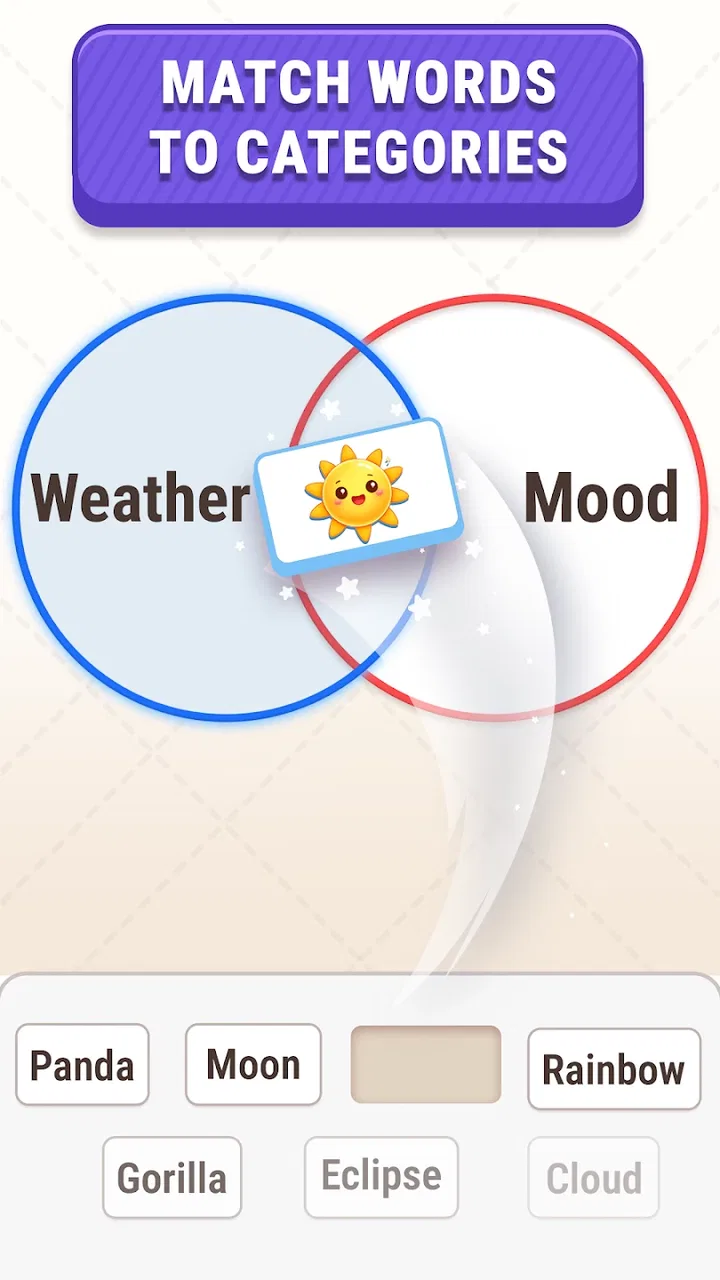
I spent time with Word Rings – Associations, a free word game from Burny Games that turns category matching into a compact daily-style mental exercise. The basic idea is easy to understand: words need to be grouped by the relationships they share, and the satisfaction comes from recognizing the connection that makes a set click. It feels more thoughtful than a simple spelling game, but less demanding than a traditional crossword or a long-form word puzzle.
What interested me most was not just whether I could solve individual groups, but whether the game gave me a good reason to keep going. A word game can be enjoyable for five minutes and still struggle to create a sense of progress. Here, the early goals are clear enough to pull me through several rounds, while the changing associations keep the activity from feeling like a vocabulary quiz. My overall impression is that it works best as a short, focused game for players who enjoy sorting ideas and spotting links between words.
How the first rounds establish the goal
The opening experience is approachable because the central action does not need much explanation. I look at a collection of words, consider possible relationships, and try to form categories that make sense together. The challenge is not merely knowing definitions. I also have to judge whether a word belongs with a group because of meaning, usage, theme, or a more indirect association.
You May Also Like

 AccuWeather: Weather Radar
AccuWeather Review: A Quick, Clear Forecast for Everyday Decisions
For everyday plans, the best forecast is the one you can understand quickly. AccuWeather makes rain timing, radar, and local conditions easy to act on, with a few trade-offs.

 Hill Climb Racing
Why Hill Climb Racing Still Turns Crashes Into One More Run
A tiny car, a bumpy hill and one more upgrade: Hill Climb Racing keeps resurfacing because its simple chaos makes every near-miss feel personal.

 AliExpress - Shopping App
AliExpress Makes Global Shopping Feel Personal, but Shoppers Bear the Risk
AliExpress turns a global marketplace into a pocket-sized discovery engine. Its reach is useful, its shopping loop compelling, and its trade-offs easy to miss.

 Lords Mobile: Kingdom Wars
Lords Mobile Is a Kingdom-Building Routine, Not a Quick Match
A case-by-case verdict on the building, battles, device demands, and social commitments that make Lords Mobile rewarding for some players and exhausting for others.

 PDF Scanner app - TapScanner
TapScanner Makes Paperwork Easier to Capture, Check, and Share
TapScanner makes scanning with a phone feel less like a rescue operation and more like a dependable step in getting work done. Its capture tools are useful, though not flawless.

 Block Blast!
 Shows How Much a Puzzle Game Can Leave Out
A quiet grid game shows why puzzle players increasingly value instant clarity, repeatable skill and low-pressure play—and where the genre still needs to catch up.
More From Our News Desk
View All News


That distinction gives the game its personality. In many basic word games, the target is visible from the start: find a hidden word, complete a spelling pattern, or answer a clue. This game asks me to create the structure myself. I am not only solving a puzzle; I am deciding which interpretation of each word is most useful.
The first practical goal is therefore simple: understand how the categories are intended to work and become comfortable testing possible combinations. I found that this makes the initial sessions feel active without being overwhelming. I can make a quick attempt when I have only a short break, yet I can also slow down and examine the wording when a group is less obvious.
That flexibility matters in an everyday setting. I could imagine opening it while waiting for an appointment, during a commute when I am not driving, or after dinner when I want something more engaging than scrolling. A round does not require the same commitment as a full story game, and the mental effort is easy to stop and resume.
Why the association format feels different
The strongest part of the design is the moment when a loose collection of words suddenly becomes organized. I might initially see several plausible pairings, but the real solution usually depends on finding a broader category rather than grabbing the first connection that appears. That creates a useful tension: a word can fit one idea while still belonging more naturally somewhere else.
This is also where the game rewards restraint. If I commit too quickly to a group, I can make the remaining words harder to interpret. My practical tip is to treat the first connection as a hypothesis, not a final answer. I scan the whole board, look for the most distinctive words, and only then decide which grouping has the cleanest logic. That approach reduces careless mistakes and makes the solving process feel more deliberate.
For younger players and casual users, the Everyone age rating makes the game broadly approachable. For adults who want a demanding vocabulary workout, however, the experience may feel lighter than a serious crossword, cryptic puzzle, or word-building game. Its appeal comes from flexible thinking and recognition, not from requiring obscure spelling knowledge.
Progress signals and the feeling of moving forward
Word games need some kind of progress signal, even when the individual puzzles are small. In my experience, the immediate signal here is the completion of a category: a messy group becomes a confirmed relationship, and the remaining choices become easier to evaluate. That small moment of order is more important than it sounds because it gives each move a clear purpose.
The broader signal comes from seeing whether I can maintain a solving rhythm. Early rounds teach me to look beyond obvious pairings, while later attempts test whether I can apply that habit without overthinking every word. I like this kind of progression because it is based on improved judgment rather than a complicated set of rules.
There is a useful trade-off in that simplicity. A player who wants visible character development, equipment, map exploration, or a story campaign will not find the same kind of advancement here. The reward is mainly the puzzle itself and the feeling that my pattern recognition is getting sharper. That can be enough for a short-session player, but it may not satisfy someone who needs a strong long-term game structure.
The current version is 1.8.23874, and the game has reached over ten thousand installs. Its average rating is 4.5 from roughly two hundred ratings, which suggests that the compact association format is landing well with the people who have tried it. I would treat those figures as useful context rather than a guarantee: enjoyment depends heavily on whether a player likes ambiguous categories and prefers thinking over fast reactions.
How I use the progress loop in practice
My preferred approach is to play in two passes. First, I make only the connections that feel nearly certain. I avoid forcing a full category just because two words seem related. Then I return to the unresolved words and ask what kind of relationship the game may be testing: a shared theme, a familiar phrase, a type of object, or a common context.
This two-pass method is more effective than repeatedly tapping random combinations. It also gives the game a small strategic layer without requiring a separate strategy system. The decision is not simply “which words match?” but “which match is strong enough to preserve the rest of the puzzle?” That is one of the less obvious strengths of the format.
Another useful habit is to pause before submitting a group that contains a very broad word. Broad words often appear to fit several categories, so I use the more specific words as anchors. If the category still makes sense after removing the flexible word mentally, it is usually a stronger candidate. This is the kind of technique that makes repeated sessions feel more rewarding because I am learning how to read the puzzle, not memorizing answers.
The game is also suitable for sharing a screen with someone nearby, although I found that the experience works best when both players explain their reasoning rather than simply taking turns guessing. One person may notice a theme while the other spots a misleading association. That makes it a pleasant low-pressure option for family play, provided everyone is comfortable with the same level of ambiguity.
Difficulty, challenge, and pacing
The difficulty curve is shaped less by speed and more by how confidently the categories reveal themselves. Some groups can be recognized quickly, while others require me to hold several interpretations in mind. That variation keeps the pace from becoming flat. If every puzzle were immediately obvious, the game would lose its purpose; if every group demanded specialist knowledge, it would become tiring rather than relaxing.
I appreciate that the challenge comes from the relationships between words instead of from a timer-driven reaction test. That makes the game accessible to players who prefer calm concentration. It also means the experience can feel very different depending on my mood. When I am alert, I enjoy the uncertainty. When I am tired, an unclear category can feel like friction rather than a satisfying obstacle.
This is where the game may not be the right choice. Players looking for rapid rounds, competitive leaderboards, or constant action should probably choose a faster word title. Likewise, anyone who dislikes answers that depend on interpretation may prefer a spelling game with one clearly correct path. Associations are the entire point here, so the occasional “I see why that works, but I would not have grouped it that way” moment is part of the package.
The pacing is strongest when I set a modest session goal instead of trying to play indefinitely. I might aim to solve a handful of puzzles, then stop while the process still feels fresh. Because the individual activity is self-contained, there is no need to turn every break into a long session. In fact, pushing beyond my attention span can make the categories blur together and reduce the enjoyment.
What makes a difficult puzzle fair
For me, a fair challenge usually has a satisfying explanation after the solution becomes clear. The category should feel intentional rather than arbitrary. When I can look back and understand why the words belong together, even after struggling, the difficulty feels worthwhile. When the connection seems too loose, the game becomes less about reasoning and more about guessing the designer's preferred interpretation.
That is an important distinction for prospective players. This is not a pure test of dictionary knowledge. It asks me to accept that words can be connected through everyday ideas and shared contexts. Someone with a broad vocabulary may still hesitate, while a player with strong lateral thinking can do well without knowing rare terms.
My advice is to avoid treating every puzzle as a contest against the clock. I get better results by naming possible categories in plain language, such as “things used together” or “words linked to one topic,” before deciding on a group. This verbal step sounds small, but it prevents me from chasing superficial similarities and helps reveal whether the connection is actually coherent.
Retention without turning every session into pressure
The game’s ability to hold my attention comes from the promise of another small association problem rather than from a heavy progression framework. Each solved group creates a little momentum, and the next puzzle offers a fresh chance to test the same reasoning skill. That is a gentle form of retention: I return because I enjoy the mental reset, not because I feel forced to maintain a complicated routine.
That approach suits people who want a free word game that can fit around ordinary life. I can open it for a short break and leave without feeling that I have abandoned a campaign. The lack of a large commitment is a genuine advantage for casual players, parents, and anyone who prefers games that respect interruptions.
At the same time, light retention can become a limitation. If I am looking for a strong reason to return every day, a growing collection of unlocks, or a sense of building toward a major destination, the association loop may not be enough on its own. The game holds attention through puzzle variety and the pleasure of solving, so its staying power depends on how much I enjoy that core activity.
I also think the free price helps lower the barrier to trying it. There is no purchase decision standing between curiosity and the first session. That makes it easy to recommend as a low-risk option for someone who already enjoys word categories, though free access alone cannot compensate if the basic style is not a match for the player.
Who will get the most from it
I would recommend it to players who like sorting, word relationships, and “one more puzzle” thinking without action-game pressure. It is especially suitable for short breaks, relaxed evening play, and shared solving with someone who enjoys discussing why a category works. It can also be a pleasant alternative to endless scrolling because it asks for active attention while remaining easy to understand.
I would be more cautious recommending it to competitive puzzle fans who need measurable rankings or to language learners seeking structured vocabulary lessons. The game may expose players to interesting relationships between words, but I would not use it as a replacement for a dedicated learning course. Its purpose is entertainment through association, not systematic instruction.
Compared with crossword games, it removes the need to work through clues and intersecting letters. Compared with anagrams, it focuses less on constructing words and more on interpreting them. Compared with trivia, it does not depend as heavily on recalling facts. Those differences make it a good middle ground for someone who wants wordplay but prefers broad concepts over spelling precision or factual recall.
My progression verdict
After playing it, I see Word Rings – Associations as a focused word game with a clear early goal, understandable progress signals, and a challenge curve built around increasingly careful interpretation. Its best feature is the way it turns ordinary words into a reasoning exercise: I am constantly checking whether a connection is strong, useful, and compatible with the rest of the puzzle.
The pacing is the main reason I would keep it installed. It works in short sessions, does not demand fast reflexes, and gives me a satisfying stopping point after a solved group or puzzle. I also value the fact that improvement comes from learning to scan the board and protect flexible words, rather than from memorizing a complicated control scheme.
There are limits. The game will not replace a full crossword collection, a competitive word ladder, or a story-driven puzzle adventure. Players who need elaborate unlocks or a powerful long-term reward structure may find the progression modest. Some associations may also feel less obvious than others, and that interpretive quality can either be the central pleasure or the biggest annoyance depending on personal taste.
For me, the balance is positive. Burny Games has made a free, Everyone-rated word title that is easy to start but gives me enough uncertainty to think carefully. With an average rating of 4.5 and a growing audience of more than ten thousand installs, it has a solid reason to attract casual puzzle fans. I would suggest trying it when you want a calm mental challenge rather than a high-pressure game, especially if the idea of organizing words into satisfying relationships sounds more appealing than chasing speed.
The best way to approach it is to play patiently, question your first assumption, and let the remaining words guide the category. That small change in mindset is what turns the game from simple matching into a more rewarding exercise in pattern recognition. If that style of thinking is enjoyable to you, this is an easy recommendation for short, thoughtful sessions.
FAQs for Word Rings – Associations
01What is Word Rings – Associations all about?
Word Rings – Associations is a puzzle game that challenges players to find associations between different words. The game presents a series of rings with letters, and players must create words that share a common theme or association. It's a fun and educational way to improve vocabulary and critical thinking skills.
02Is Word Rings – Associations free to play?
Yes, Word Rings – Associations is available for free on both Android and iOS platforms. However, the game may offer in-app purchases for additional hints or ad-free experiences. Players can enjoy the core gameplay without spending any money, but optional purchases can enhance the experience.
03How many levels does Word Rings – Associations have?
The game offers a wide range of levels, gradually increasing in difficulty as you progress. Each level presents new challenges and unique word associations. While the exact number of levels may vary with updates, players can expect hours of engaging gameplay with plenty of puzzles to solve.
04Can I play Word Rings – Associations offline?
Yes, Word Rings – Associations can be played offline, allowing you to enjoy the game without an internet connection. This makes it perfect for on-the-go entertainment, whether you're traveling or simply in an area with limited connectivity. Just make sure to download the game while online.
05Are there any ads in Word Rings – Associations?
Word Rings – Associations does feature ads, as it is a free-to-play game. These ads help support the developers and keep the game free for everyone. Players can opt to remove ads through in-app purchases if they prefer an uninterrupted gaming experience.
Pros
- Engaging and intuitive gameplay.
- Stimulates cognitive and associative thinking.
- Simple and user-friendly interface.
- Regular updates with new levels.
- Offline play available
- no internet needed.
Cons
- Limited hints can be frustrating.
- Ads can interrupt the gameplay.
- Some associations are too obscure.
- In-app purchases can be pricey.
- Repetitive themes may bore some players.

Word Rings – Associations
Gallery